A Day Among the Ruins: How Ayutthaya Unfolds from Morning to Golden Hour
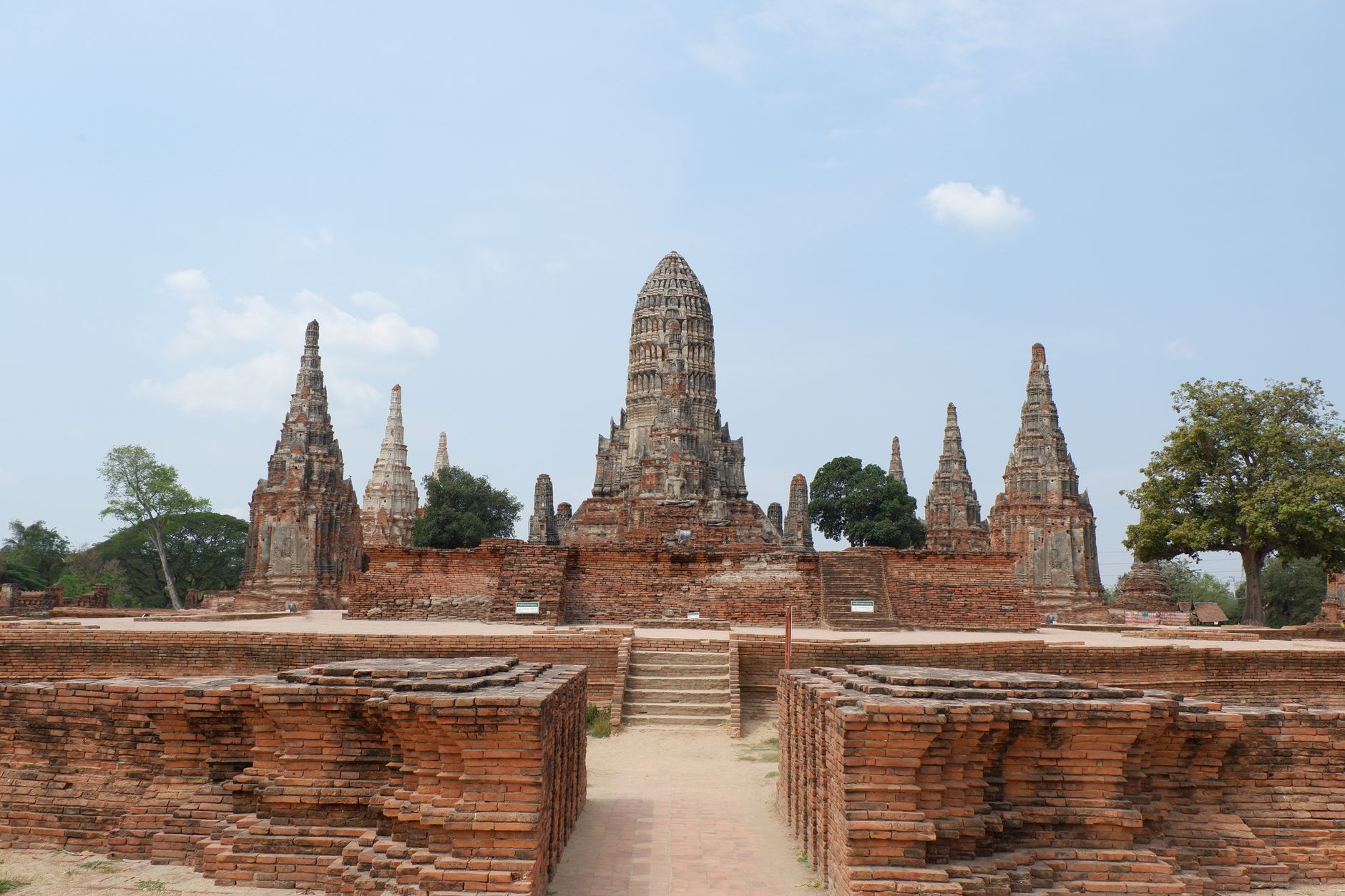
Ayutthaya sits about 80 kilometers north of Bangkok, close enough that most travelers see it as a day trip and far enough that the day needs a shape. The old capital is not one site but an island of them — a historical park scattered across several square kilometers, ringed by rivers, with working streets threaded between the ruins. Wander it without a plan and the midday heat will make the decisions for you. Structured well, a single day here covers four centuries of Siamese history and still ends with the light show that photographers cross the world for.
Here is how that day tends to unfold.
Morning: Wat Mahathat before the heat
The park opens early, and early is when you want to be at Wat Mahathat. This is the temple with the famous Buddha head cradled in the roots of a banyan tree — the single most photographed object in Ayutthaya — and by mid-morning there's a queue to photograph it. Arrive near opening and you'll share the site with birdsong and a handful of other early risers.
The head is the postcard, but the temple around it is the story. Wat Mahathat was one of the most important monasteries of the kingdom, founded in the 14th century, and its central prang once rose roughly 40 meters before the Burmese army toppled it in 1767. What remains — rows of headless Buddha images, brick foundations, chedis leaning at improbable angles — reads like a freeze-frame of that year. A guide earns their keep here: without the context, it's picturesque rubble; with it, it's the sacking of one of the largest cities in the world at the time.
Two practical notes for temple grounds anywhere in Thailand, and doubly so here: shoulders and knees covered, and never pose above a Buddha image — for the tree-root head, that means crouching so your own head stays below it. A staff member is usually posted nearby to remind photographers.
Late morning: the royal temple
A few minutes away stands Wat Phra Si Sanphet, the holiest temple of the old royal palace — the Ayutthaya-era equivalent of Bangkok's Temple of the Emerald Buddha. Its three aligned chedis, restored and gleaming grey-white against the sky, are the emblem of the city; they held the ashes of three 15th-century kings. This is where the scale of old Ayutthaya lands. The palace that adjoined this temple has vanished almost entirely, and the lawns where it stood give the chedis room to breathe. Late morning light is still workable for photos here, and the site is more open than Wat Mahathat, so it absorbs crowds better.
By now it's approaching noon, the pavement is radiating, and every sensible itinerary does the same thing: gets off the island for lunch and a change of register.
Midday: Bang Pa-In, the summer palace
Twenty minutes south of the old city, the Bang Pa-In Royal Palace is Ayutthaya's counterpoint — not ruins but a manicured 19th-century royal retreat, largely built under King Chulalongkorn (Rama V). The compound mixes styles with cheerful confidence: a Chinese-style mansion, a Swiss-chalet residence, an observatory tower, and, floating in the middle of an ornamental pond, the Aisawan Thiphya-Art pavilion — a gilded Thai pavilion that appears on more Thai postcards than almost any building outside Bangkok.
Bang Pa-In works precisely because of when you visit it. The grounds are shaded, the pace is a stroll, and golf-cart rentals cover the distances if the heat has won. It is still a royal property, so the dress code is enforced at the gate — the same covered shoulders and knees as the temples.
Afternoon: the river makes sense of the map
Ayutthaya is an island city; three rivers meet around it, and for four hundred years they were its highways, its moat, and the reason foreign trading ships anchored here from Japan, Persia, Portugal, and France. Seeing the city from the water — whether from a riverside temple terrace or a boat — reorders your mental map. Temples that seemed scattered reveal themselves as riverfront addresses. This is also when the day trip from Bangkok shows its one weakness: rushed itineraries skip the water entirely and shuttle between parking lots.
Golden hour: Wat Chaiwatthanaram
The day ends across the river to the southwest, at Wat Chaiwatthanaram — a 17th-century temple built on a Khmer plan, its central prang flanked by eight chedi-chapels in tight formation. It is the most complete large temple in Ayutthaya and the most cinematic, which is why it fills with photographers, and visitors in rented traditional dress, as the sun drops. The warm light on the laterite and brick lasts perhaps forty minutes. After dark, several of the major ruins, this one included, are illuminated — a sight day-trippers on a tight Bangkok turnaround never see.
That's the argument for doing Ayutthaya as part of an overnight itinerary rather than a there-and-back sprint: the two best hours at the ruins are the first and last of the day, and a rushed day trip catches neither.
Doing it as part of a longer route
Travelers comparing ways to see the heritage corridor have a few options, and choosing between them mostly comes down to pace and depth. For those short on time, Asia Bound's Thailand Heritage Escape covers this ground in a compact 5-day, 4-night loop — Bangkok, Kanchanaburi and the River Kwai, then Ayutthaya — from $499 per person, land only ($479 on the current sale through September 15). It starts and ends in Bangkok with no U.S. flight leg, which makes it easy to bolt onto a longer Southeast Asia trip. The itinerary is operated on the ground by BCX, an independent local operator based in Bangkok, with guides who handle the timing choreography above so you don't have to.
Travelers with more time fold Ayutthaya into the longer northern routes — the Thailand Discovery (12 days) continues north to Sukhothai, Chiang Mai, and Chiang Rai, tracing the older capital the Ayutthaya kingdom itself succeeded.
However you come, come early, carry water, cover your shoulders, and save Wat Chaiwatthanaram for last. The city fell in a single year; it deserves more than a single hurried afternoon.